Key Takeaways
- Rain barrels capture rooftop runoff that would otherwise saturate soil near your foundation.
- Sizing your barrel to your roof's square footage prevents overflow that defeats the whole purpose.
- Every barrel system needs a working overflow outlet that directs excess water well away from your home.
- Proper gutter downspout drainage must stay intact; rain barrels supplement it, they do not replace it.
- Seasonal maintenance, including winterizing before freeze season, keeps the system working year after year.
Why Rain Barrels Matter for Gutter Systems
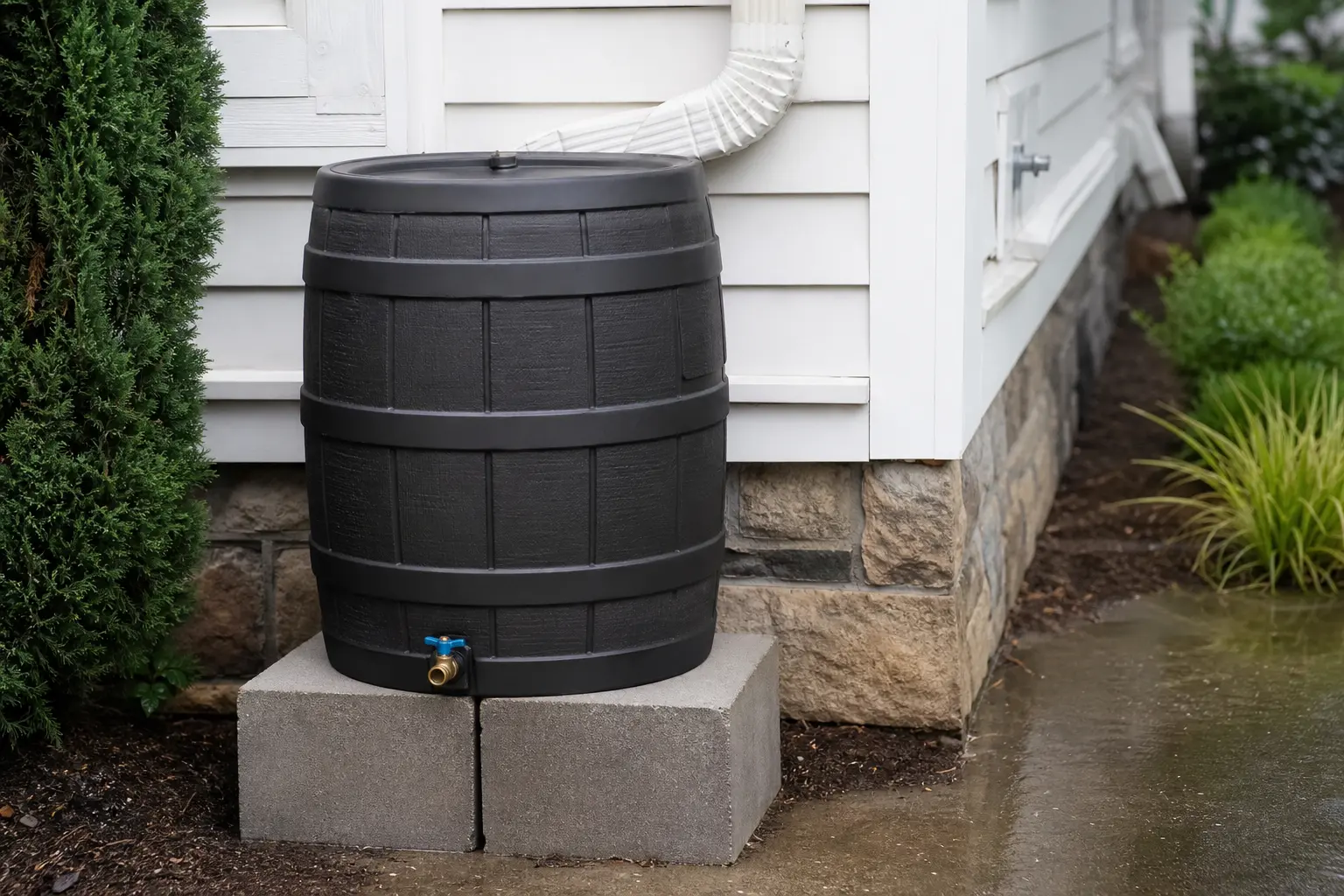
A properly installed rain barrel captures runoff from your roof before it can saturate the soil around your foundation, reducing erosion and lowering the risk of basement leaks without interrupting normal gutter drainage.
Rain barrels for gutters do more than collect free water for your garden. They sit at the intersection of water conservation and home protection, making them one of the more practical upgrades a Rochester homeowner can add to an existing gutter system.
Foundation damage from uncontrolled runoff
When a downspout dumps water right at the base of your home, that water has nowhere to go but into the soil immediately around your foundation. Over time, that repeated saturation leads to hydrostatic pressure, cracked footings, and basement moisture problems. In the Rochester area, where spring thaws and summer thunderstorms can deliver heavy rain in short bursts, unmanaged runoff is a real risk.
A rain barrel intercepts that flow before it hits the ground, giving you control over where the water goes. Even a single 55-gallon barrel can remove a meaningful volume of runoff from your foundation zone during a moderate rain event.
Water conservation and cost savings
According to the EPA's Rain Barrel resource, a typical roof can collect roughly 0.6 gallons of water per square foot during a one-inch rain event. For a modest 1,500-square-foot roof, that's around 900 gallons from a single storm. Capturing even a fraction of that volume offsets outdoor watering costs and reduces demand on municipal water supplies.
Reducing strain on municipal drainage systems
When every home in a neighborhood sends 100 percent of its rooftop runoff into the street, storm drains get overwhelmed fast. Rain barrels slow that surge. Communities across Monroe County have encouraged residential rainwater collection precisely because it reduces peak load on shared infrastructure, especially during the heavy spring rains the region sees regularly.
How to Choose and Size Rain Barrels for Your Gutters
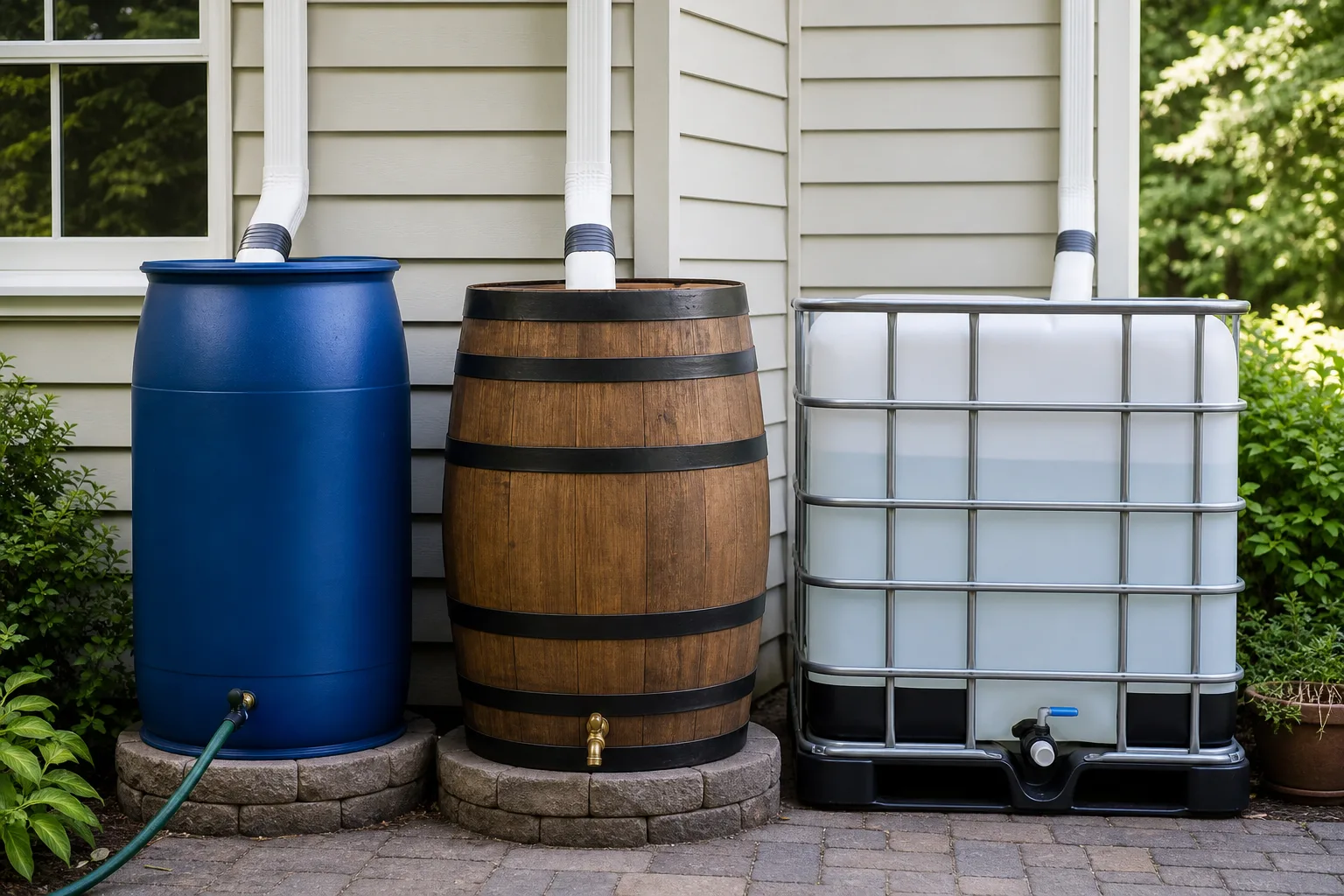
Picking the right barrel is about matching capacity to your roof's output, then choosing a material that holds up in upstate New York's climate.
Calculating the right barrel capacity for your roof area
A useful rule of thumb: multiply your roof's square footage by 0.6 to estimate gallons collected per inch of rain. From there, consider how quickly you'll use that water. If you have a large garden that drains a full barrel between rains, a 55-gallon barrel may be perfectly adequate.
If the barrel sits full for days, overflow becomes your primary concern and you need either a larger system or a well-designed overflow outlet.
| Roof Area (sq ft) | Approx. Gallons per 1" Rain | Recommended Starting Capacity |
|---|---|---|
| 500 | ~300 gal | 55-gallon single barrel |
| 1,000 | ~600 gal | 55-gallon + overflow hose |
| 1,500 | ~900 gal | Dual 55-gallon or 100+ gal barrel |
| 2,000+ | ~1,200+ gal | Multiple barrel or large cistern |
Material options and durability considerations
Food-grade polyethylene barrels are the most common choice. They're UV-resistant, lightweight, and widely available. Repurposed food-grade containers (olive or pickle barrels are popular) work well too, as long as they seal tightly to block light and prevent algae growth.
Wooden barrels look attractive but require more maintenance and can crack during freeze-thaw cycles, which makes them a less practical option for Webster and Rochester winters.
Single vs. multiple barrel systems
A single barrel works fine for a small roof section or a low-use scenario. Linking two or more barrels in series using a connector hose at the base lets you double or triple capacity without adding more downspout diverters. The overflow from barrel one fills barrel two before spilling out, giving you a buffer during prolonged rain events.
Installing Rain Barrels Without Blocking Drainage
Proper rain barrel installation keeps your existing gutter system fully functional. The goal is to intercept some of the flow, not all of it, and to make sure overflow has a clear path away from your home.
Proper downspout diverter placement and setup
A downspout diverter is a fitting that inserts into your downspout and redirects flow into the barrel when it's below capacity. When the barrel is full, the diverter automatically sends water back down the original downspout path. Installing it at the correct height is critical: the barrel inlet should sit slightly below the diverter outlet so gravity moves the water without backpressure.
If your downspout needs extending or repositioning to reach a practical barrel location, that's a good time to evaluate your overall downspout installation layout and make sure every outlet drains at least six feet from the foundation.
Overflow mechanisms and secondary drainage paths
Every barrel must have a dedicated overflow outlet near the top. A short length of garden hose or PVC pipe connected at the barrel's overflow port should direct excess water to a garden bed, a gravel bed, or a low point in your yard, away from the foundation. Never leave the overflow port uncapped or aimed at your home's base.
Foundation clearance and slope requirements
As a general guideline, water should discharge at least 6 to 10 feet from your foundation, and the ground should slope away from the house at a minimum of 1 inch of drop per foot for the first several feet. If your soil is flat or your yard naturally drains toward the house, a barrel system alone won't solve the problem. You'll also want to revisit your gutter drainage setup to ensure downspouts are positioned to direct flow away from problem areas.
Managing Overflow During Heavy Rain Events
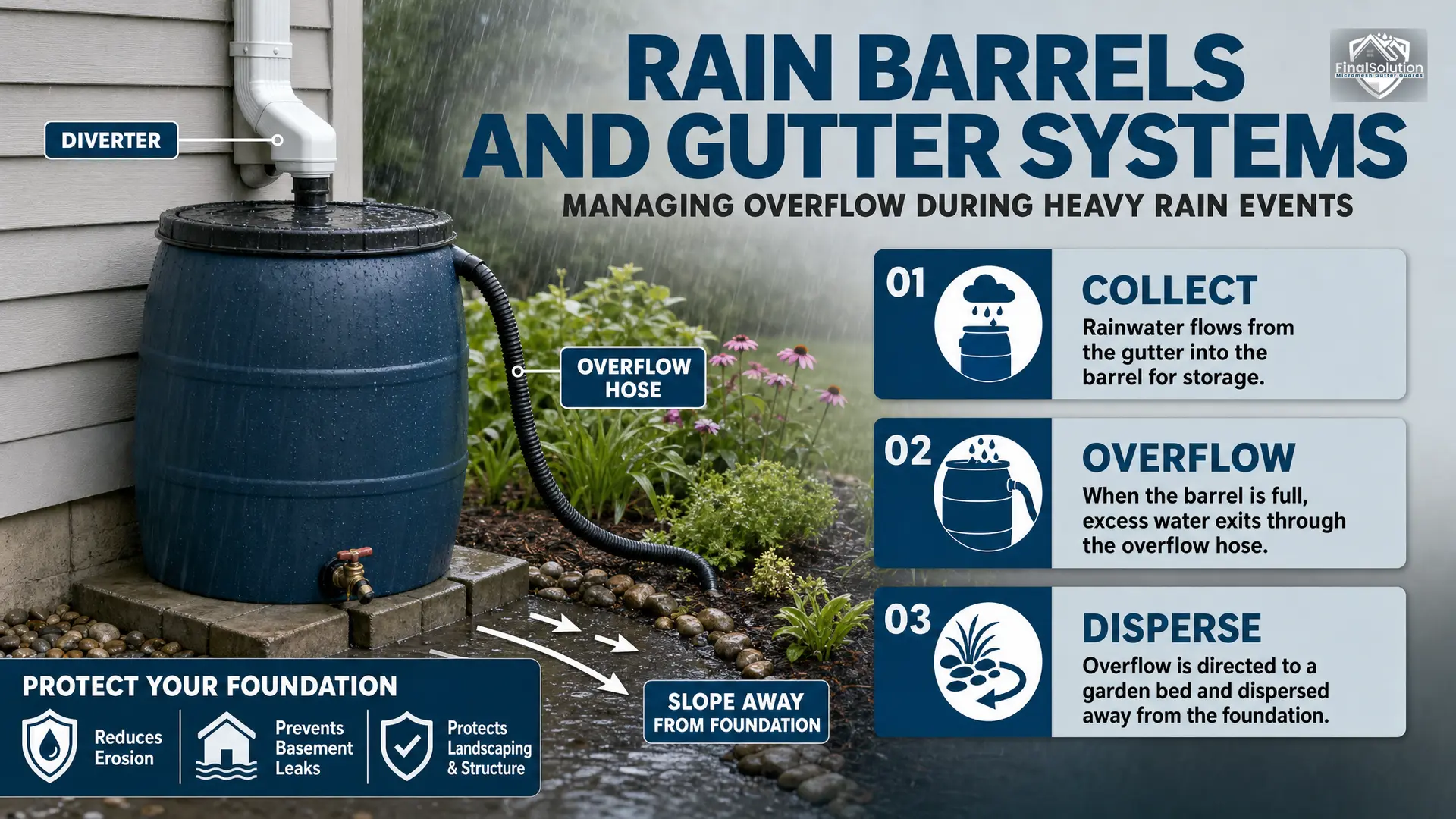
Rochester can receive several inches of rain in a single event, especially in spring and fall. A 55-gallon barrel fills in minutes during a hard downpour, so your overflow strategy matters as much as the barrel itself.
Overflow hoses and where they should drain
Route your overflow hose to a rain garden, a vegetated slope, or a gravel infiltration area. These spots absorb water gradually rather than letting it sheet across pavement or concentrate near your home. Avoid routing overflow toward a neighbor's property or a low-lying area that already stays wet.
Integrating rain barrels with existing downspout systems
Rain barrels work best when they're one layer in a complete drainage plan, not the only one. Your gutters and downspouts need to be clean, properly pitched, and free of leaks for the whole system to function. If debris is clogging your gutters upstream, the barrel receives dirty, debris-laden water that clogs its inlet screen quickly.
That's worth keeping in mind before you invest in a barrel setup. Homeowners dealing with frequent clog issues might also benefit from reading about when to repair, replace, or add gutter guards before adding a barrel to the mix.
Preventing water pooling near the foundation
If you're already seeing ponding near your foundation after a storm, a rain barrel alone won't fix that. You need to address the root drainage issue first. Check that your downspout extensions reach far enough, that your grading slopes away from the home, and that no buried drainage is blocked.
Once baseline drainage works correctly, a barrel system adds a useful layer of control on top.
For homeowners in the Webster and Rochester area dealing with persistent drainage problems, a gutter inspection and repair is often the right first step before adding any new components.
Rain Barrels vs. Traditional Gutter Solutions in 2026
Rain barrels complement, not replace, traditional gutter drainage. Each solution handles a different part of the runoff problem, and the best setups often combine them.
Comparison with french drains and sump pumps
French drains and sump pumps address water that has already reached your foundation or crawl space. Rain barrels prevent excess surface runoff from getting there in the first place. They serve different stages of the same problem.
| Solution | Primary Function | Best Use Case | Approx. Cost Range |
|---|---|---|---|
| Rain barrel | Capture and reuse runoff | Gardens, lawns, water conservation | $50-$200 per barrel |
| French drain | Redirect subsurface water | Saturated soil, flooding yards | $1,500-$5,000+ installed |
| Sump pump | Remove water from foundation | Basement flooding, high water table | $1,000-$3,000+ installed |
| Downspout extension | Extend surface discharge | Short downspouts dumping near foundation | $5-$50 per extension |
The gutter drainage relationship between gutters and foundation water management is well documented: gutters fail their core function when debris blocks flow, when downspouts are too short, or when outlets point toward the house. Fixing those fundamentals first makes every other solution more effective.
Cost analysis and ROI timeline
A basic rain barrel installation setup costs between $50 and $200 for a single barrel with a diverter kit. If you use that water on a vegetable garden or lawn through the growing season, the offset in municipal water use can recover that cost in one to three years depending on local water rates and usage volume.
Multi-barrel systems or larger cisterns cost more upfront but collect proportionally more water and reduce overflow risk across a full property. For most Monroe County homeowners, starting with a single well-placed barrel and a proper diverter kit is the most practical starting point.
When to combine rain barrels with other drainage strategies
Rain barrels make the most sense when your gutters are already functioning well and you want to add a layer of water management on top. If your yard slopes toward the house, your downspouts are undersized, or you're seeing basement moisture after every rain, address those structural issues first. A barrel paired with properly sized seamless gutters and well-placed downspout extensions gives you the strongest overall drainage setup.
Think of rain barrels as the final layer, not the foundation. Gutters handle the bulk of the flow. Downspouts direct it away from the home.
Barrels capture what's useful and return the rest through a controlled overflow path.
Maintenance and Seasonal Care for Rain Barrel Systems
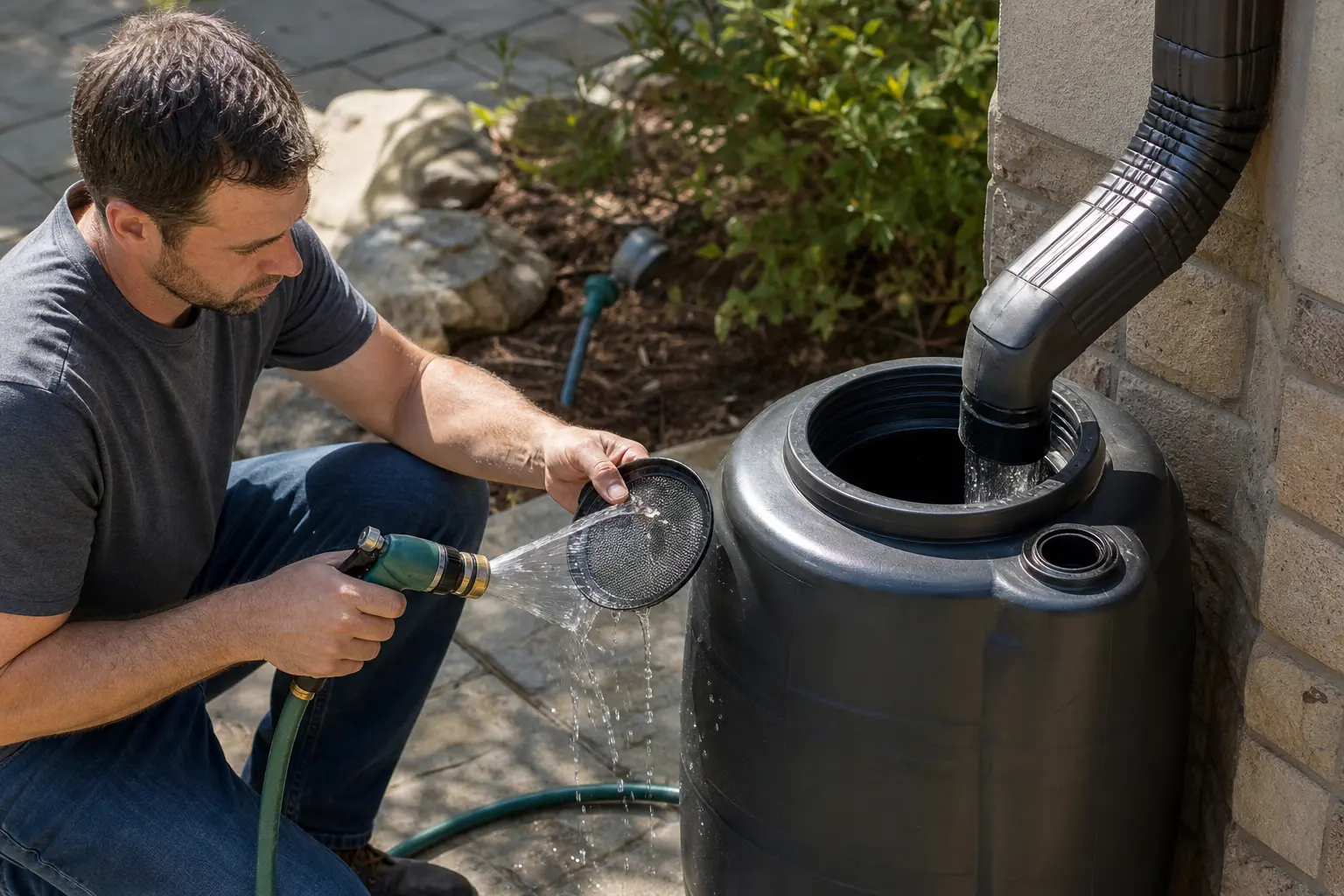
A rain barrel only stays useful if you keep it clean and functioning through every season. In the Rochester area, that means paying special attention to late fall and early winter prep before freeze temperatures arrive.
Cleaning screens and preventing mosquito breeding
Your barrel's inlet screen is the first line of defense against debris and standing-water pests. Clean it every four to six weeks during the active season, or more often if your trees drop a lot of material into the gutters. A fine mesh screen with openings no larger than 1 millimeter prevents mosquitoes from laying eggs in the stored water.
Without it, a full barrel becomes a breeding ground within days during warm weather.
Also check that your barrel lid seals completely. Light exposure encourages algae growth, and gaps in the lid let insects in. A quick rinse of the barrel interior at the start of each season keeps sediment from building up at the bottom and blocking the spigot.
Winter preparation and freeze protection
This step is non-negotiable for Monroe County homeowners. Water expands when it freezes, and a full barrel that freezes solid can crack or warp beyond repair. Before the first hard freeze, typically by late October or early November in the Webster and Rochester area:
- Drain the barrel completely through the spigot or overflow port.
- Disconnect the downspout diverter and restore normal downspout flow for winter.
- Store the barrel in a garage or shed if possible, or at minimum tip it upside down so meltwater can't collect inside.
- Cap the downspout opening temporarily to keep debris from entering while the barrel is disconnected.
Reconnecting in spring is straightforward once temperatures stay consistently above freezing, usually mid-April in this region.
Troubleshooting common overflow and drainage issues
| Problem | Likely Cause | Fix |
|---|---|---|
| Barrel fills and overflows immediately | Overflow hose too short or aimed at foundation | Extend hose, redirect to garden or gravel bed |
| Slow fill or no water entering barrel | Clogged inlet screen or blocked diverter | Remove and rinse screen, clear diverter opening |
| Water backing up into downspout | Barrel positioned too high, blocking flow | Lower barrel or check diverter valve function |
| Algae or odor inside barrel | Light exposure or infrequent cleaning | Seal lid completely, rinse barrel at season start |
| Mosquito activity around barrel | Gap in lid or screen | Replace or repair screen, ensure lid seals fully |
If overflow is consistently reaching your foundation despite a working overflow hose, the issue may be upstream: a clogged gutter or an undersized downspout that sends water surging through faster than the diverter can redirect it. That's a sign to schedule a gutter inspection and make sure the system feeding your barrel is in good shape. Homeowners across the Rochester area can reach out to the team at Final Solution Gutter Guards ROC to diagnose and fix those upstream problems before they undermine your rainwater setup.
Frequently Asked Questions
Can a rain barrel damage my foundation if it overflows?
Yes, it can, if the overflow isn't directed away from your home. A barrel that fills and spills water at the base of your downspout creates the same problem as having no barrel at all. Every installation needs a dedicated overflow hose routed to a garden bed, gravel infiltration area, or a low point in the yard that naturally drains away from the house.
Proper slope and discharge distance are just as important as the barrel itself.
How many rain barrels do I need for a typical Rochester home?
It depends on your roof size and how quickly you'll use the water. For a 1,000-square-foot roof section, one 55-gallon barrel captures only a small fraction of runoff from a one-inch rain event. If water conservation is your main goal, linking two or three barrels in series gives you more storage and reduces how often the overflow kicks in.
If foundation protection is the priority, the overflow system matters more than barrel count.
Do rain barrels work with gutter guards installed?
Yes. Gutter guards keep debris out of your gutters, which means the water flowing into your barrel is cleaner and your inlet screen stays clear longer. In fact, a well-functioning gutter guard system upstream is one of the best ways to extend the time between barrel maintenance sessions. You can learn more about compatible setups on the gutter guards page.
Is rainwater harvesting legal in New York State?
New York State does not restrict residential rainwater harvesting for outdoor use. Homeowners can collect and store rooftop runoff in barrels or cisterns without a permit for purposes like irrigation and lawn watering. If you plan to use collected water indoors or for potable purposes, different regulations apply and you should check with your local municipality.
For standard outdoor use, barrels connected to a residential gutter system are straightforward and legal.
What size downspout do I need to connect a rain barrel properly?
Most residential homes use either 2x3-inch or 3x4-inch rectangular downspouts, and standard diverter kits are available for both sizes. Round downspouts are less common but also accommodated by most kit manufacturers. The diverter fitting slides into the downspout at the barrel inlet height, so the key measurement is how high you can position the barrel while still leaving room for a spigot and a bucket underneath.
A minimum clearance of about 12 inches below the spigot is practical for filling a watering can.
When should I call a professional instead of DIYing a rain barrel setup?
A basic single-barrel installation with a diverter kit is genuinely a manageable DIY project for most homeowners. Where it gets more complex is when your downspout needs to be cut, extended, or repositioned to reach a good barrel location, or when your grading and drainage aren't working correctly in the first place. If you're unsure whether your existing gutter system can support a barrel setup, or if you've been dealing with persistent foundation moisture, it's worth getting a professional eye on the full drainage picture before adding new components.
 Contact Us for a Free Estimate! Share a few details with Final Solution Gutter Guards ROC, we'll help you choose the right next step. Get a free estimate |